
Chinese Humanoid Robots Shatter Usain Bolt”s 100m Record at the World Humanoid Robot Games in Beijing
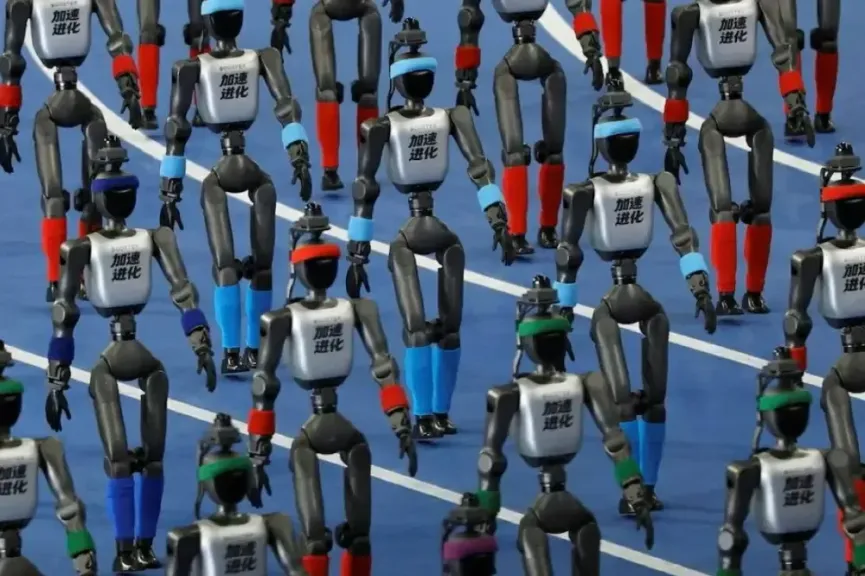
Humanoid robots in China have proven they can sprint faster than the fastest humans in history. However, developers stress that the true challenge now lies in assessing whether these machines can master less glamorous, highly precise industrial tasks—such as packaging, warehouse logistics, and delicate cable connections.
On Saturday, the five-day World Humanoid Robot Games kicked off in Beijing. The event blends competitions inspired by traditional human athletics with rigorous practical scenarios simulating factory floors, restaurants, office environments, and emergency response operations.
Promoted heavily by Chinese state media and supported by Huawei as the official technical partner, the tournament features 51 distinct competitions. According to Huawei, over 40% of these challenges require the robots to operate entirely autonomously without human intervention.
Athletic Feats: Robots vs. Human World Records
The most spectacular moments of the opening day occurred on the track, where robotics engineering eclipsed legendary human athletic milestones. However, engineers noted that deceleration and balance remain significant hurdles, as the high-speed sprinters struggled to stop, ultimately crashing into thick safety mats placed beyond the finish line.
The table below compares the robotic track performances on Day 1 against existing human World Records:
Track EventHuman World Record HolderHuman Record TimeRobot Performance (2026)Notes / Observations
100-Meter SprintUsain Bolt (Jamaica)9.58sSub-9.58sTwo distinct robots broke the record. (A massive improvement from 2025, where the winning robot took >20s).
400-Meter SprintWayde van Niekerk (South Africa)43.03s39.7sCompleted by a robot of the same model as the 100m winner.
Competition Structure & Industrial Integration
While the athletic feats draw public attention, the core focus of the event is accelerating humanoid integration into the workforce. The 51 competitions are divided into two primary categories:
Athletic Competitions (30 Events): Designed to test raw physical capabilities, bipedal balance, locomotion speed, and structural durability.
Practical Scenarios (21 Events): Focused on fine motor skills, spatial awareness, and autonomous problem-solving in real-world settings (e.g., executing complex warehouse maneuvers and performing delicate hardware connections).
As humanoid speed and agility reach unprecedented levels, the industry's benchmark for success is rapidly shifting from physical stunts to reliable, autonomous commercial utility.