
Banks Test Reusable Identity Verification to Reduce KYC Friction
A pilot observed by the Financial Crimes Enforcement Network (FinCEN) is testing whether banks and FinTechs can reuse completed customer-verification work through standardized records, potentially reducing repeated know-your-customer (KYC) checks without requiring receiving institutions to accept another firm’s risk assessment.
The initiative is being coordinated with the U.S. Treasury Department, the Office of the Comptroller of the Currency and the Federal Deposit Insurance Corp. It comes as banks and FinTechs contend with inconsistent verification results, excessive checks and friction during digital onboarding.
Repeated Verification Adds Cost and Friction
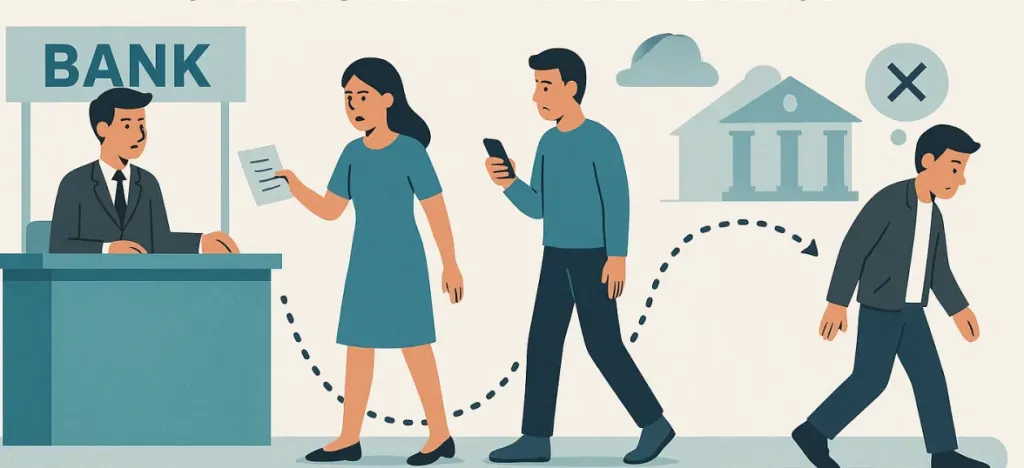
Under the current system, a customer who has already cleared identity verification at one financial institution may still have to repeat much of the process when opening an account or establishing a new relationship elsewhere.
For banks and FinTechs seeking to move more customers through digital onboarding, those repeated checks add cost and friction to a process already producing inconsistent results.
The PYMNTS Intelligence report, “When ‘Good Enough’ Isn’t Enough: Digital Identity Verification in the Age of Bots and Agents,” found in January that 74.6% of financial services firms said their verification technology produces inconsistent identity results.
Meanwhile, 56.3% reported customer friction caused by excessive checks, 46.5% said different identity platforms produce different results, and 43.7% cited high manual review costs.
Verification Problems Can Limit Growth
According to the report, 76% of financial services firms generate at least three-quarters of their revenue through digital channels, making identity verification a direct part of customer acquisition for much of the industry.
The effects can extend beyond onboarding. Some 76.1% of financial services firms said KYC and know-your-business (KYB) processes had prevented them from adding or expanding customers, markets or geographic coverage.
Onboarding abandonment caused by friction was reported by 55% of firms, while 49% said onboarding delays hurt conversion or increased the time required to deliver value.
SOLO Launches Bank-Reliance Pilot
The SOLO Network announced this month that it had launched a FinCEN-observed bank-reliance pilot designed to test whether completed customer-verification work can be reused.
SOLO compared the initiative with “TSA PreCheck,” saying it is intended to allow trusted verification work to move between participating financial institutions instead of requiring customers to restart the process whenever they establish a new financial relationship.
Standardizing How Verification Work Is Documented
Under the model, participating institutions create standardized, auditable verification records that document the evidence reviewed, work performed and standards applied.
A receiving institution can then assess that record against its own compliance and risk requirements.
The model does not require the receiving institution to automatically accept another institution’s work. Each institution retains responsibility for its own compliance decisions and independently determines whether the verification it receives satisfies its requirements.
Participating institutions also do not have to conduct verification using identical processes. The standardization applies instead to how completed work is documented and evaluated.
Customers Can Authorize Reuse of Prior Verification
For consumers and businesses, the model is intended to reduce repeated verification when establishing relationships with additional financial institutions.
SOLO said customers can authorize participating institutions to evaluate verification that has already been completed rather than starting the identity-verification process again.
The initiative is narrower than creating a new KYC regime. Instead, it tests whether verification completed by one institution can be represented in a standardized form that another institution can review and potentially use.
Pilot Will Test Whether Duplication Can Be Reduced
The initiative targets a specific source of onboarding friction identified in PYMNTS Intelligence research. Financial services firms face challenges not only in verifying customers, but also in determining how many checks are necessary, how much manual work those checks generate and whether different verification platforms reach consistent results.
The SOLO pilot will test whether reusable records can eliminate at least some of that duplication across banks and FinTechs.
The key operational measure will be how often a receiving institution can use previous verification without substantially recreating the original work. If standardized records prove workable across participating institutions, verification completed during one onboarding could potentially be used in a subsequent financial relationship.