
Vivo S2 vs Redmi Note 17: Why Vivo May Be the Smarter Buy
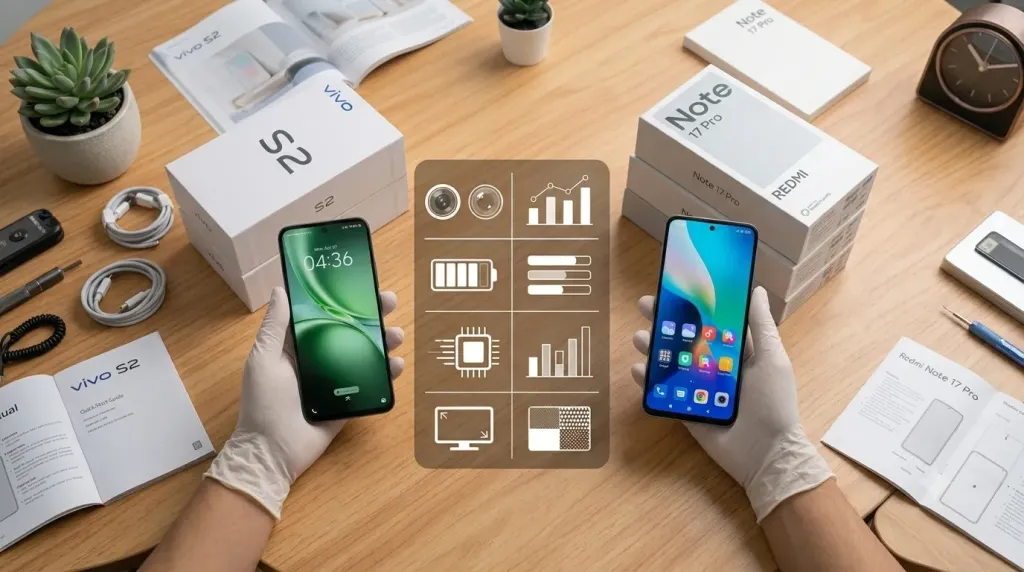
As Vivo prepares to unveil the Vivo S2, the upcoming smartphone is already shaping up as a direct rival to Xiaomi’s Redmi Note 17 in an increasingly competitive mid-range market.
At first glance, Redmi appears to have the advantage in the numbers game. Leaked specifications point to a 7-inch display, Qualcomm’s Snapdragon 4 Gen 4 processor and a sizeable 8,000mAh battery supported by 45W charging.
Yet bigger figures do not necessarily translate into a better everyday smartphone. Based on the information currently available, the Vivo S2 could emerge as the more balanced option, particularly for buyers who prioritise design, display quality, cameras and charging speed over battery capacity alone.
A More Premium Display Experience
Reports surrounding the Vivo S2 suggest the phone could feature a 6.83-inch AMOLED display with a sharper 1.5K resolution and a 120Hz refresh rate. The Redmi Note 17, by comparison, is expected to use a larger 7-inch screen with Full HD resolution.
The Redmi’s additional screen size may appeal to users who watch videos or play games frequently, but Vivo’s expected AMOLED panel and higher resolution could deliver stronger contrast, deeper blacks and a more refined viewing experience.
Its slightly smaller dimensions may also make the Vivo S2 more comfortable to handle, avoiding the oversized feel that increasingly accompanies smartphones approaching the seven-inch mark.
Vivo Could Hold the Performance Advantage
The Vivo S2 has been linked to MediaTek’s Dimensity 7360 Turbo platform, although Vivo has yet to confirm the final hardware. That would position the device above the Snapdragon 4 Gen 4 expected inside the standard Redmi Note 17.
Should these specifications prove accurate, Vivo could offer stronger processing and graphics performance, giving it an advantage in multitasking, gaming, image processing and long-term usability.
The Redmi Note 17 may still be perfectly capable for social media, video streaming and everyday applications, but its expected processor suggests that Xiaomi is placing greater emphasis on affordability and battery endurance than outright performance.
Battery Size Is Not the Whole Story
Xiaomi’s expected 8,000mAh battery is likely to be one of the Redmi Note 17’s strongest selling points, exceeding the 7,000mAh capacity associated with the Vivo S2.
However, Vivo may compensate with considerably faster charging. Reports suggest that the S2 could support charging at up to 90W, compared with 45W on the Redmi. This could make the Vivo handset more convenient for users who prefer shorter charging sessions rather than maximum battery capacity.
Redmi is therefore likely to win on pure endurance, while Vivo could provide the more practical balance between battery life, charging speed