
Egypt Opens Market to US Vehicle Safety Standards (FMVSS) During Investment Minister”s Visit to General Motors Plant
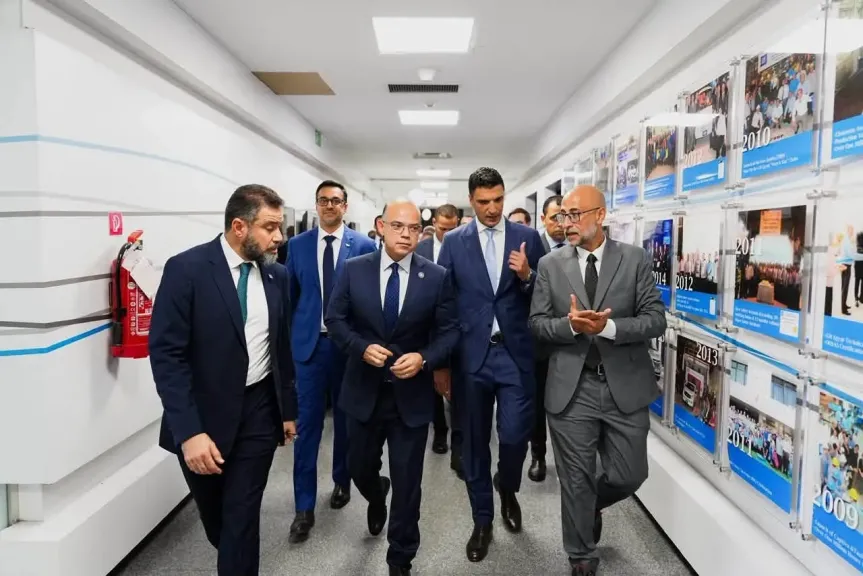
Dr. Mohamed Farid Saleh, Minister of Investment and Foreign Trade, paid a strategic visit to the General Motors (GM) Egypt plant in 6th of October City. During the tour, he inspected the production lines and reviewed the company's expansion plans for the Egyptian market.
The Minister also participated in a milestone ceremony announcing the opening of the Egyptian market to vehicles compliant with the US Federal Motor Vehicle Safety Standards (FMVSS). The event was attended by Eng. Khaled Hashem, Minister of Industry; Mr. Stephen Haynes, US Assistant Secretary of Commerce; Mr. Robert Silverman, Chargé d'Affaires at the US Embassy in Cairo; and Mr. Rohan Fernandez, CEO and Managing Director of General Motors Egypt and Africa, alongside several corporate officials and representatives from both the Egyptian and US governments.
A Decades-Long Strategic Partnership
Dr. Saleh emphasized that the relationship between Egypt and General Motors stands as one of the oldest economic partnerships between Egypt and the United States, spanning over four decades. He noted that this enduring alliance reflects profound mutual trust in the Egyptian economy, highlighting the state's unwavering commitment to creating an attractive investment climate that empowers global corporations to expand and increase their investments in the local market.
The Minister added that this milestone underscores the competitive capacity of the Egyptian economy to attract major industrial investments. Through continuous state-led reforms aimed at improving the business environment, Egypt is bolstering the confidence of multinational companies, supporting their ambitions for production, expansion, and export.
Deepening Local Manufacturing and Regional Positioning
Dr. Saleh outlined that the government is operating an integrated framework to deepen local manufacturing and increase the proportion of local components in the automotive sector. This is driven by close coordination across relevant authorities—primarily the Ministry of Industry—ensuring seamless alignment of investment, industrial, and financing policies to achieve the nation's strategic production and competitiveness goals.
He further noted that Egypt possesses robust fundamentals qualifying it as a regional automotive hub. A strategic geographic location, advanced infrastructure, and an extensive network of free trade agreements grant investors unparalleled access to vast regional and international markets.
According to data from the General Authority for Investment and Free Zones (GAFI), the Egyptian market currently hosts over 2,000 American companies across various sectors, demonstrating the economy's diversity and appeal. Dr. Saleh pointed out that Egyptian-US economic relations are built on mutual interests, with several Egyptian enterprises successfully maintaining investments within the US market.
Comprehensive Economic Reforms and Data-Driven Policies
The Ministry of Investment and Foreign Trade continues to execute a comprehensive reform program designed to streamline business operations.
Key Reforms Include:
Simplifying administrative procedures.
Facilitating capital increases for companies.
Upgrading the investor services ecosystem.
Modernizing mechanisms for mergers and acquisitions (M&A) to align with international best practices.
Dr. Saleh stressed that formulating effective economic policies relies heavily on accurate, up-to-date data. The Ministry is actively completing its comprehensive investment database, ensuring companies update their information and submit financial statements in compliance with the law. This initiative aims to bridge the time gap between data availability and decision-making, thereby elevating the efficiency of economic planning.
Embracing US Safety Standards (FMVSS)
Addressing the adoption of the US Federal Motor Vehicle Safety Standards (FMVSS), the Minister framed the decision as a core component of the state's reform agenda to facilitate product access to the Egyptian market. This move is expected to heavily support GM’s expansion plans and reinforce multinational confidence in Egypt’s industrial landscape.
"This step opens a clear pathway for increasing exports of US vehicles and auto parts to the Egyptian market," said Stephen Haynes, US Assistant Secretary of Commerce. Noting that US auto exports to Egypt exceeded $256 million last year, Haynes added: "These regulatory changes will provide Egyptian consumers with greater opportunities to acquire safe, reliable, and high-quality American vehicles and parts, while enhancing economic prospects in both nations."
General Motors’ Vision for the Market
Rohan Fernandez, CEO and Managing Director of General Motors Egypt and Africa, lauded the regulatory update.
"General Motors Egypt welcomes the agreement concluded with the Egyptian government to adopt the US FMVSS. This represents a significant milestone for the Egyptian automotive sector and a positive measure toward a more open and transparent market for US-manufactured vehicles and parts. It perfectly aligns with GM’s 100-year legacy in the Middle East and Africa—a journey that began right here in Egypt," Fernandez stated.
Fernandez highlighted that the new framework provides a highly efficient and transparent regulatory path, which recently facilitated the successful reintroduction of the Cadillac brand to Egypt in May. "This step reflects how regulatory advancements can translate into tangible commercial results—broadening consumer choice, fostering fair competition, and solidifying Egypt's status as a promising, strategic market for the automotive industry," he added.
Concluding Remarks
Wrapping up his visit, Dr. Mohamed Farid Saleh reaffirmed the Egyptian government’s dedication to sustaining robust partnerships with major global entities. By supporting their expansion strategies, the state aims to localize industries, maximize local content, drive export growth, and generate sustainable employment opportunities, cementing Egypt's position as an attractive regional epicenter for investment and manufacturing.