
Egypt Activates TIR International Road Transport System with New Customs Guarantee Agreement
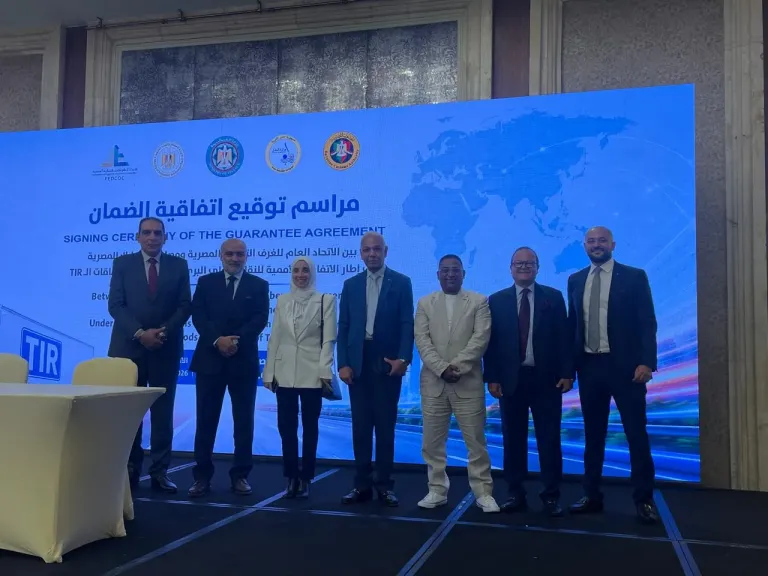
The Egyptian Federation of Chambers of Commerce, in cooperation with the Egyptian Customs Authority, officially signed the guarantee agreement to activate the International Road Transport (TIR) Carnets system. The signing ceremony and accompanying press conference took place in the New Administrative Capital.
The activation comes in response to presidential directives to transform Egypt into a prominent regional and global transport and logistics hub. It also serves as the operational implementation of Presidential Decree No. 391 of 2030, which finalized Egypt’s accession to the 1975 Geneva Customs Convention on the International Transport of Goods.
High-Profile Attendance
The event was attended by several senior government officials, policy makers, and private sector leaders, including:
Lieutenant General Kamel Al-Wazir, Minister of Transport.
Dr. Mohamed Farid, Minister of Investment and Foreign Trade.
Key executives from the Egyptian Customs Authority and the Federation of Egyptian Chambers of Commerce.
Khaled Sabry, Head of the International Transport Division at the Federation of Chambers of Commerce.
Eng. Medhat El-Kady, Board Member and President of the Egyptian Businessmen’s Association.
Prominent logistics and private sector representatives, including Issam El-Shazly, Ahmed Mostafa, Abd El-Al Ali, Amr Abd El-Al, El-Antabli, and Abd El-Latif Abd El-Moneim.
Strategic Advantages of the TIR System
The TIR system is widely recognized as a highly secure and efficient international transit system. Its implementation in Egypt is expected to yield substantial economic advantages:
Simplified Customs Procedures: Facilitates the seamless cross-border movement of trucks and transit goods through globally standardized customs controls.
Reduced Transit Times: Minimizes delay points at border crossings, thereby significantly decreasing overall customs clearance times.
Lower Logistical Costs: Decreases operational expenses for shipping and transport companies, lowering the retail cost of goods.
Optimized Supply Chains: Elevates the security and efficiency of regional supply networks, linking Egypt more effectively to European and regional trade partners.
"The agreement is a strategic leap forward to enhance Egypt's investment environment, bridge the gap between public policy and private enterprise, and leverage Egypt's unique geographical position through an advanced network of highways, ports, and dry log zones."
Conference participants concluded by emphasizing the need for sustained collaboration between state authorities and private sector operators to ensure the seamless execution of the TIR protocols, ultimately driving sustainable economic growth and expanding Egypt's international trade footprints.