
Textile Industries Chamber Explores Expanding Solar Power Plants in Factories in Cooperation with the Environmental Compliance Office
hamdy Abdelrashid
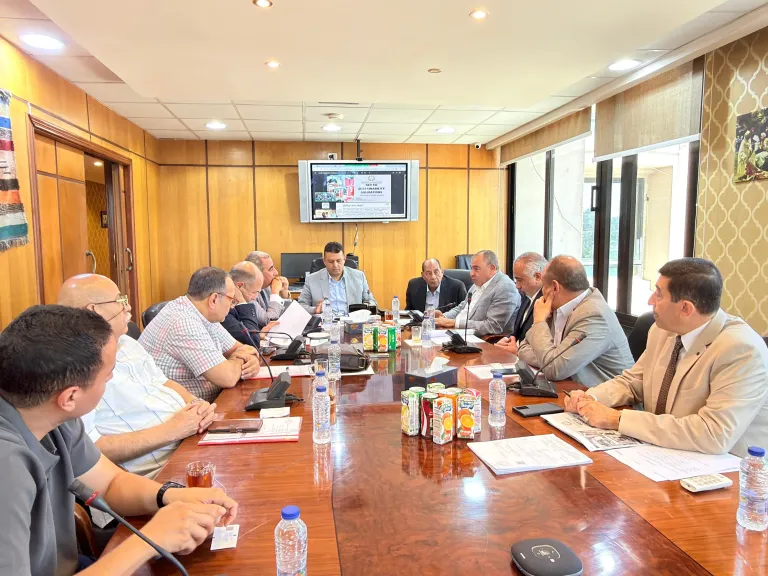
The Board of Directors of the Textile Industries Chamber at the Federation of Egyptian Industries (FEI), chaired by Mohamed El-Kateb, discussed mechanisms for expanding the establishment of solar power plants within spinning, weaving, and ready-made garment factories. The discussions, held in collaboration with the Environmental Compliance and Sustainable Development Office (ECO SD), align with the state's strategy to increase reliance on renewable energy sources, reduce production costs, and enhance the competitiveness of Egyptian industries.
The meeting was attended by Sayed El-Barhamtoushy and MP Ahmed Shaarawy, Deputy Chairmen of the Chamber, and Eng. Abdel Ghani Al-Abasiri, the Chamber's representative on the FEI Board of Directors. Also present were board members Mahmoud El-Morshedy, Eng. Sherif Wagdy, Eissa Mostafa, Eng. Ahmed Badr, Mahmoud El-Fouty, Mostafa El-Sheikh, and Islam Abou El-Enein, alongside Khaled El-Beheiry, the Chamber's Director, and Eng. Ahmed Kamal, Executive Director of the ECO SD at the FEI.
Renewable Energy as a Pillar for Competitiveness
During the meeting, Mohamed El-Kateb stated that the transition to renewable energy has become a primary pillar for developing the industrial sector, particularly given the rising environmental requirements of global markets and the critical need to lower operating costs. He highlighted that the Chamber is actively working to familiarize factories with technical and financing solutions that facilitate the seamless implementation of solar energy projects.
El-Kateb added that the textile sector is highly energy-intensive, making investments in solar power one of the most effective tools to cut production costs and improve operational efficiency. This, in turn, will positively impact the competitiveness of Egyptian products in both local and export markets. He confirmed that the Chamber, in cooperation with the ECO SD, will organize a series of workshops in the near future to introduce funding programs and encourage factories to adopt clean energy solutions.
Maintaining Access to Global Markets
Eng. Abdel Ghani Al-Abasiri emphasized that shifting to clean energy is no longer optional but an economic and export necessity. He noted that global markets are increasingly linking imports to sustainability standards and carbon emission reductions.
Al-Abasiri pointed out that reducing operating costs will directly boost the competitiveness of Egyptian products and open new export avenues. He praised the collaboration between the Chamber and the ECO SD as a practical step to support factories—especially small and medium-sized enterprises (SMEs)—by offering flexible solutions that allow them to adopt solar energy without heavy investment burdens.
Flexible Financing Solutions
Eng. Ahmed Kamal, Executive Director of the ECO SD, explained that the office, established in 2001, serves 22 industrial chambers by supporting factories in environmental compliance, energy conservation, and sustainable development through comprehensive technical and financial services.
He revealed that the office, in cooperation with the Ministry of Environment, offers a revolving finance program providing factories with up to EGP 12 million at a declining interest rate of 3.5%, featuring a one-year grace period and a four-year repayment plan. This funding covers solar power plants, energy efficiency projects, and eco-friendly production equipment.
Kamal outlined two options for factories to benefit from solar energy:
Direct Ownership: Acquiring the solar plant through the office's soft financing program.
Power Purchase Agreement (PPA): An approved company fully funds and installs the solar plant on the factory's roof, selling the generated electricity to the factory at a discount of up to 20% compared to government tariffs, requiring zero initial investment from the factory.
He concluded that solar energy is now vital for the continuity of industrial activities and securing stable energy supplies amid global market fluctuations.