
YouTube has launched parent-controlled children”s accounts in the Middle East and North Africa region, to provide more protection and features for children and parents.
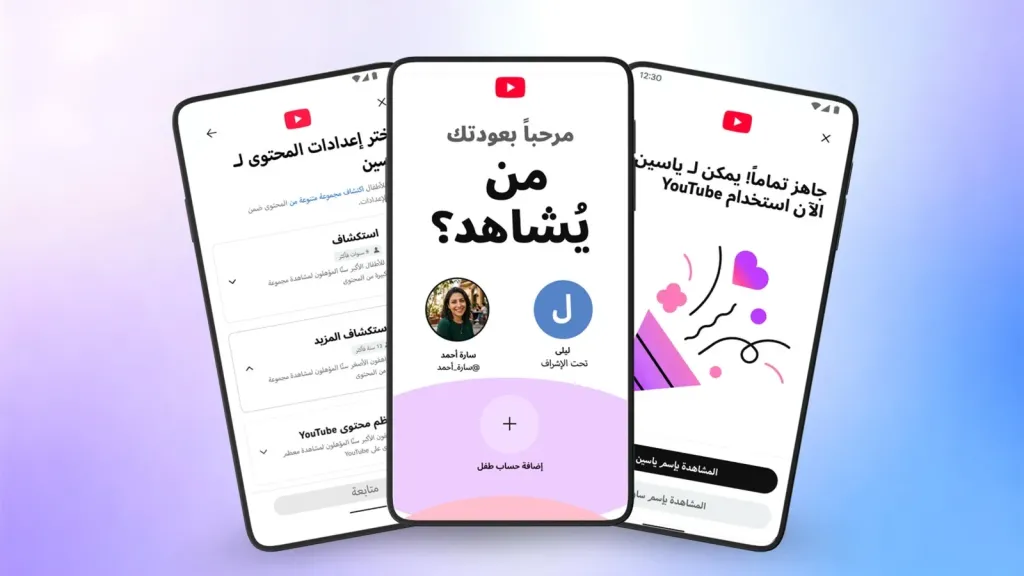
YouTube today announced the launch of parent-supervised children's accounts in the Arab world, including Egypt. These accounts represent YouTube's latest steps in developing digital experiences suitable for different age groups, as these accounts allow children to explore their interests and develop their curiosity on the platform, while providing higher levels of protection and privacy.
Recognizing the different needs of each family and every child, supervised children's accounts provide advanced control tools and a customized, age-appriate environment within the main YouTube app. The use of these accounts remains optional, as parents can stop them at any time if they want to provide full access to all YouTube content for their children.
Supervised children's accounts include three content setting options that parents can choose from, each generally corresponding to international content classifications. These settings include the Explore option, which includes educational content, tutorials, arts and handicrafts; the Explore more option, which adds game content and live streaming; and the Most of YouTube content option, which allows access to most videos on YouTube except classified content for those over 18 or not suitable for supervised accounts.
In addition to content settings, supervised children's accounts provide a set of easy-to-use tools that help parents choose the most suitable settings for their children. Among them are Shorts, the first of its kind in the sector, which allows a daily duration of shorts. Parents can also set the timer to zero to stop browsing the entire short clips, for example during the test period.
Supervised children's accounts also include a set of built-in protections, which are automatically activated for all users under the age of 18. These include “take a break from watching” and “bedtime” reminders, to encourage balanced use of the platform, as well as disable the ability to create content or write comments, and not display personalized ads, while content automation remains disabled by default.
The children's accounts launched today join the parent-supervised teen accounts, which are already available to families across the region. Teen accounts provide an optional experience that allows them to explore most YouTube content while supporting more effective communication between teens and their families by linking accounts, sending email notifications, and providing access to information about channel activity.
On this occasion, Javed Aslanov, President of YouTube in the Middle East and North Africa, said: “YouTube has been a part of the lives of families across the region for more than 20 years, both to help with homework and to enjoy watching content with family members. With this in mind, we continue to invest in developing tools that support families and prioritize children's safety.”
For his part, Garth Graham, head of health at YouTube, said: “Our priority is to protect children and young people while using the digital world, not to deprive them of it. The accounts of parents-controlled children and adolescents contribute to providing a safe space that allows them to learn and explore, while providing appropriate protection tools and controls that enhance their safety and give families the freedom to choose the most suitable experience for their children.
The launch of supervised children's and teen accounts is an extension of YouTube's ongoing commitment to providing a safer family experience, a commitment that spans more than a decade and is guided by a team of independent experts in the field of child development. For younger children, YouTube Kids also offers a stand-alone app with a selection library of age-friendly videos. For its part, the Google Family Link application allows parents a range of parental control tools that help them set rules for using digital devices, manage the use of applications, filter content, and track the location of a child's Android phone. YouTube continues to invest in the development of tools that enhance the safety of children and young people and maintain their privacy to ensure that these aspects remain its top priority.