
WorkShift 2026 Opens with Government Backing to Position Egypt as a Regional Hub for Freelancing and Digital Talent
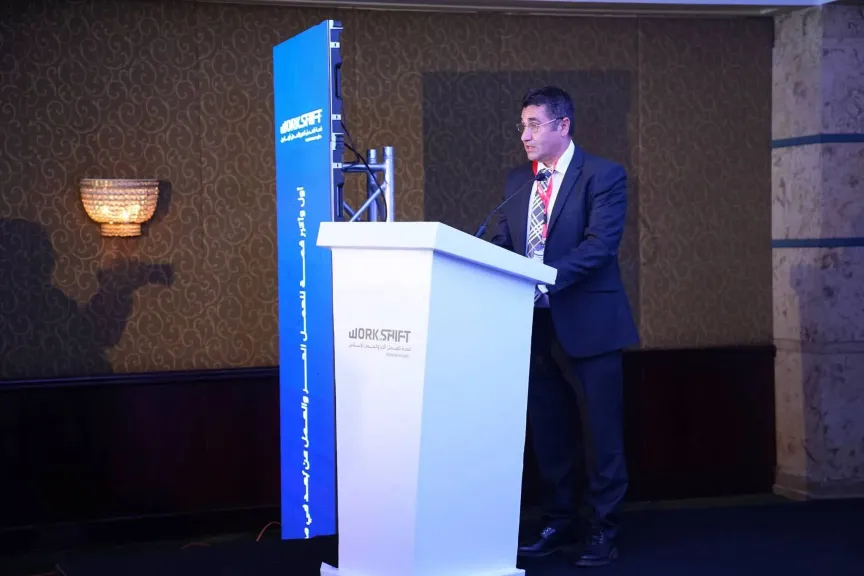
Egypt’s first executive summit dedicated to freelancing, remote work, and the digital economy, WorkShift 2026, officially opened on Sunday with senior government officials, technology leaders, and business executives highlighting human capital as the country's most valuable asset and a key driver of future economic growth.
The summit was inaugurated in the presence of Hassan Raddad, Minister of Labour; Dr. Hoda Baraka, Advisor to the Minister of Communications and Information Technology for Technological Skills Development and Honorary President of the Summit, representing Raafat Hindi, Minister of Communications and Information Technology; Mahmoud Safrata, Vice President for Market Development at the Information Technology Industry Development Agency (ITIDA); and Mohamed El Haddad, Vice Chairman of the Chamber of Information Technology and Telecommunications (CIT), alongside more than 200 CEOs, business leaders, and technology experts.
In his keynote address, Minister of Labour Hassan Raddad said Egyptian youth continue to demonstrate strong competitiveness in the global labor market, emphasizing that the government is modernizing labor legislation and developing a regulatory framework that supports freelancers and independent professionals while ensuring adequate legal protection for this rapidly expanding segment of the workforce.
He stressed that Egypt's political leadership recognizes the strategic importance of modern work models and called for practical recommendations that would help establish an integrated legislative framework capable of supporting the country's digital economy and positioning Egypt as a regional exporter of digital talent and services.
Nermine El Nemr, Founder of WorkShift Summit and CEO of Mantek Management, Training & Technology Solutions, said Egypt's greatest competitive advantage lies in its human capital rather than its natural resources.
She noted that the summit was established to create practical collaboration between government institutions and the private sector with the goal of transforming Egypt into a regional hub for digital talent and cross-border services.
"Our message to young Egyptians is simple: don't wait for opportunities—create them," El Nemr said, highlighting Egypt's growing digital infrastructure and its large pool of skilled university graduates.
Addressing the summit, Mohamed El Haddad, Vice Chairman of CIT and CEO of EDGECOM Egypt, described freelancing as a strategic pillar of the digital economy rather than merely an employment option for young people.
He emphasized that cloud computing, data centers, and cybersecurity have become the backbone of modern economies, adding that Egypt's digital future depends on strengthening local technology production, integrating freelancers into the formal economy, and increasing the participation of Egyptian technology companies in national projects to boost digital exports.
Meanwhile, Dr. Hoda Baraka said artificial intelligence is fundamentally reshaping the global labor market and creating entirely new career opportunities, making digital competencies, communication skills, foreign languages, management, and negotiation increasingly essential for international competitiveness.
She revealed that the number of freelancers in Egypt increased from approximately 390,000 to 890,000 by the end of 2025, helping the country improve its global freelancing ranking from 35th to ninth worldwide.
Baraka added that the Ministry of Communications and Information Technology, through ITIDA, continues to expand training initiatives designed to equip young Egyptians with digital skills and connect them with both domestic and international employment opportunities.
For his part, Mahmoud Safrata, Vice President for Market Development at ITIDA, said freelancing has become one of the fastest-growing contributors to Egypt's ICT sector and digital services exports.
He noted that Egypt is now among the world's top ten freelancing markets, reflecting the growing capabilities of Egyptian professionals in delivering competitive digital services globally.
Safrata also announced that ITIDA is preparing a new package of incentives and support programs for freelancers aimed at enhancing their international competitiveness, increasing digital exports, and reinforcing Egypt's position as a leading destination for outsourcing, technology services, and cross-border digital business.