
Fixed Solutions Issues New Report on Cybersecurity Trends in the Middle East and Africa
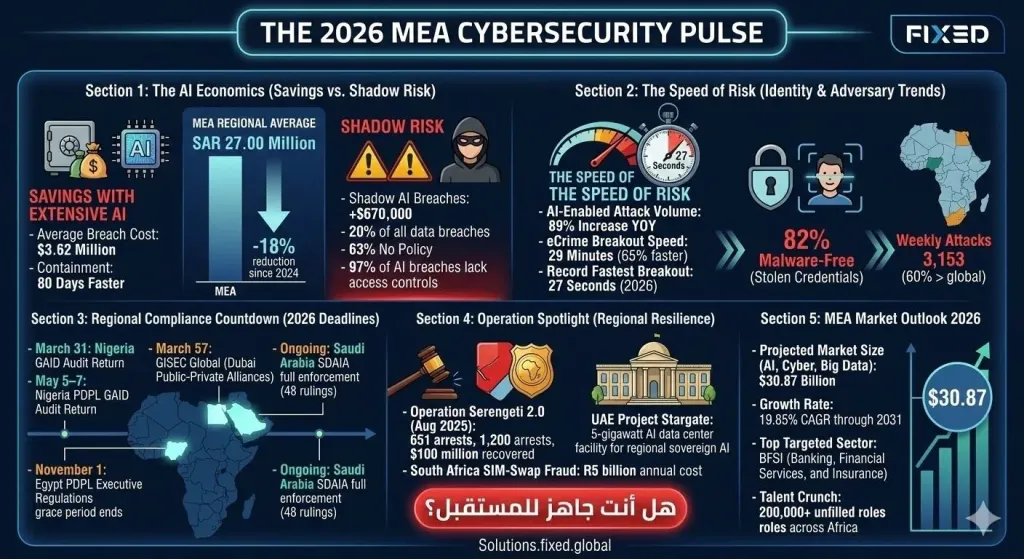
Fixed Solutions has released its latest analytical report titled “Cybersecurity Trends 2026 in the Middle East and Africa,” highlighting the major transformations shaping the cybersecurity landscape across the region amid accelerating digital adoption and the growing sophistication of AI-powered cyber threats.
The report indicates that 2026 represents a decisive shift in the global cyber risk management model, as organisations gradually move away from traditional network-boundary defenses toward more advanced approaches based on autonomous systems and cyber resilience. This transition is largely driven by the rapid development of artificial intelligence technologies, particularly Agentic AI, which is capable of making decisions and executing tasks independently.
According to the report, the Middle East and Africa are experiencing this transformation alongside an unprecedented pace of digitalisation and growing geopolitical challenges. This dynamic environment positions the region simultaneously as an emerging hub for technological innovation and a target for increasingly complex cyber threats.
The findings reveal that 94% of global cybersecurity leaders believe artificial intelligence will be the most influential factor shaping cyber threats in 2026. In the Middle East and Africa, around 62% of organisations are expected to increase their cybersecurity budgets this year, while nearly half are prioritising the adoption of artificial intelligence and machine learning tools to address the growing shortage of specialised cybersecurity talent.
However, the report also warns of the rising risks associated with “Shadow AI,” referring to the use of artificial intelligence tools within organisations without oversight from IT departments. Estimates suggest that nearly 40% of organisations already have unsupervised AI usage, which may threaten data sovereignty and expose sensitive information to potential leaks beyond organisational or national boundaries.
Digital identity emerging as the first line of defense
The report emphasises that traditional network boundaries are no longer sufficient to protect organisations, as digital identity has become the primary line of defense in cybersecurity strategies.
Data cited in the report shows that 82% of detected cyber breaches in 2025 involved malware-free attacks, relying primarily on stolen credentials rather than malicious software.
It also highlights the rapid growth of Non-Human Identities, including API keys, service accounts, and AI agents, which now outnumber human identities within many digital systems. This trend is significantly increasing the complexity of identity and access management within organisations.
Rising cybersecurity challenges in Africa’s mobile finance sector
The report notes that African markets with widespread adoption of mobile financial services are facing increasing cybersecurity risks. One of the most prominent threats is SIM-swap fraud, which causes annual losses exceeding 5 billion rand in South Africa alone.
Additionally, the data shows that 78% of digital banking fraud cases in the country are linked to phishing attacks, highlighting the growing need for stronger digital security frameworks in financial services.
Regional preparedness for future technological threats
The report also highlights proactive measures taken by several Gulf countries to prepare for the cybersecurity risks associated with quantum computing, which could potentially undermine current encryption systems.
In February 2025, the UAE National Cybersecurity Council launched a $2 billion initiative aimed at developing quantum-resistant encryption technologies as part of a broader regional shift toward Post-Quantum Cryptography (PQC).
Stronger data protection regulations on the horizon
The report underscores the rapid evolution of data protection regulations across the region. In Egypt, Personal Data Protection Law No. 151 of 2020 is expected to reach full enforcement by the end of 2026.
The law will require organisations to report data breach incidents within 72 hours and appoint a Data Protection Officer (DPO) responsible for overseeing compliance and safeguarding personal information.
Similar regulatory developments are also underway in countries such as Saudi Arabia, the United Arab Emirates, and Nigeria, reflecting a broader regional push to strengthen data protection frameworks and regulate cross-border data transfers.
Cybersecurity market poised for strong growth
According to the report, the combined market for artificial intelligence, cybersecurity, and big data analytics in the Middle East and Africa is expected to reach $30.87 billion by 2026, with a projected compound annual growth rate (CAGR) of 19.85% through 2031.
Fixed Solutions concluded that these developments signal a new phase for cybersecurity in the region, one that will increasingly rely on artificial intelligence, proactive cyber resilience strategies, and stronger regional collaboration to address the growing complexity of digital threats while supporting the rapid expansion of the digital economy.
The full report can be accessed through the following link:
https://solutions.fixed.global/ar/news/ai-cybersecurity-middle-east-africa-2026-ar