
Milano–Cortina 2026 Exposes Europe’s Payment Dependency as Visa Dominates Olympic Transactions
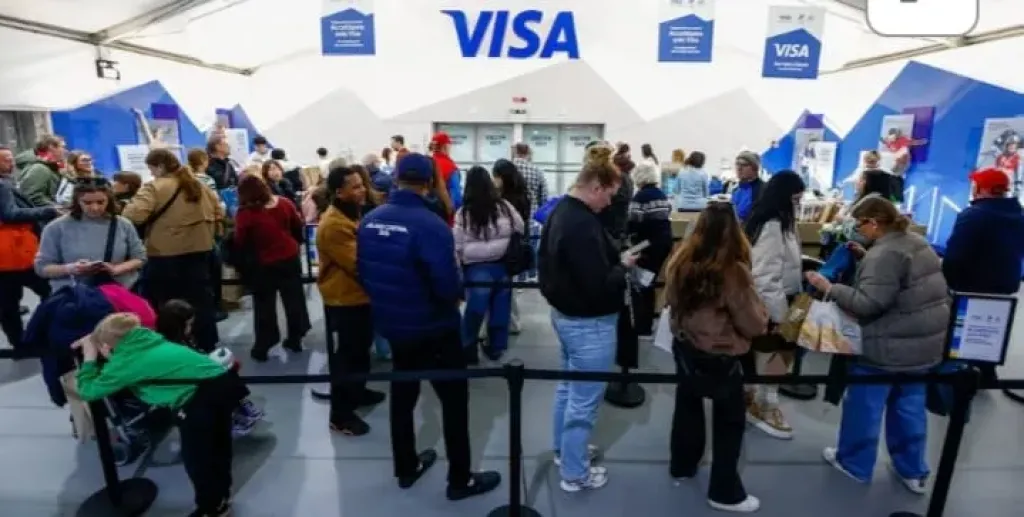
The Milano–Cortina Winter Olympics 2026 has highlighted a growing gap in Europe’s payments ecosystem, after Visa emerged as the exclusive card payment provider inside official Olympic stores. This exclusivity stems from a long-term sponsorship agreement with the International Olympic Committee extending through 2032.
Signage inside Olympic retail outlets delivered a clear message: “Paying by card? Visa only.” Visitors without Visa cards were directed to purchase prepaid cards, despite organizers confirming that cash payments remained accepted and ATMs were available. In practice, however, cash usage appeared limited, with store staff estimating that only around one-sixth of customers relied on cash, while Visa cards dominated the remaining transactions.
The situation has reignited debate across Europe over the eurozone’s dependence on non-European payment networks. Data from the European Central Bank shows that international schemes such as Mastercard, alongside Visa, account for nearly two-thirds of card transactions in the euro area, intensifying concerns over control of critical payments infrastructure.
Against this backdrop, the ECB is accelerating efforts to launch the digital euro by 2029, positioning it as a strategic project to strengthen the European Union’s financial autonomy. The digital euro is designed as a central bank–issued payment instrument that would function both online and offline, complement cash and providing Europeans with a secure, locally governed alternative.
The initiative had faced legislative delays for more than two years amid concerns over its potential impact on commercial bank deposits and private payment systems. Recently, however, it has gained renewed political momentum as geopolitical tensions rise and the concept of “economic sovereignty” gains prominence within EU policymaking circles.
Additional criticism emerged after some Olympic venues initially restricted sales to cashless payments only, forcing certain customers to abandon purchases due to the lack of accepted payment methods. Some stores later reversed course and reinstated cash acceptance.
Ultimately, the global sporting event evolved into a real-world stress test of Europe’s payment system resilience in the face of external dominance. As digital payments accelerate and cash usage declines, Europe faces a defining choice between commercial efficiency and speed on one hand, and monetary sovereignty and consumer choice on the other—an inflection point likely to shape the continent’s payments landscape in the years ahead.