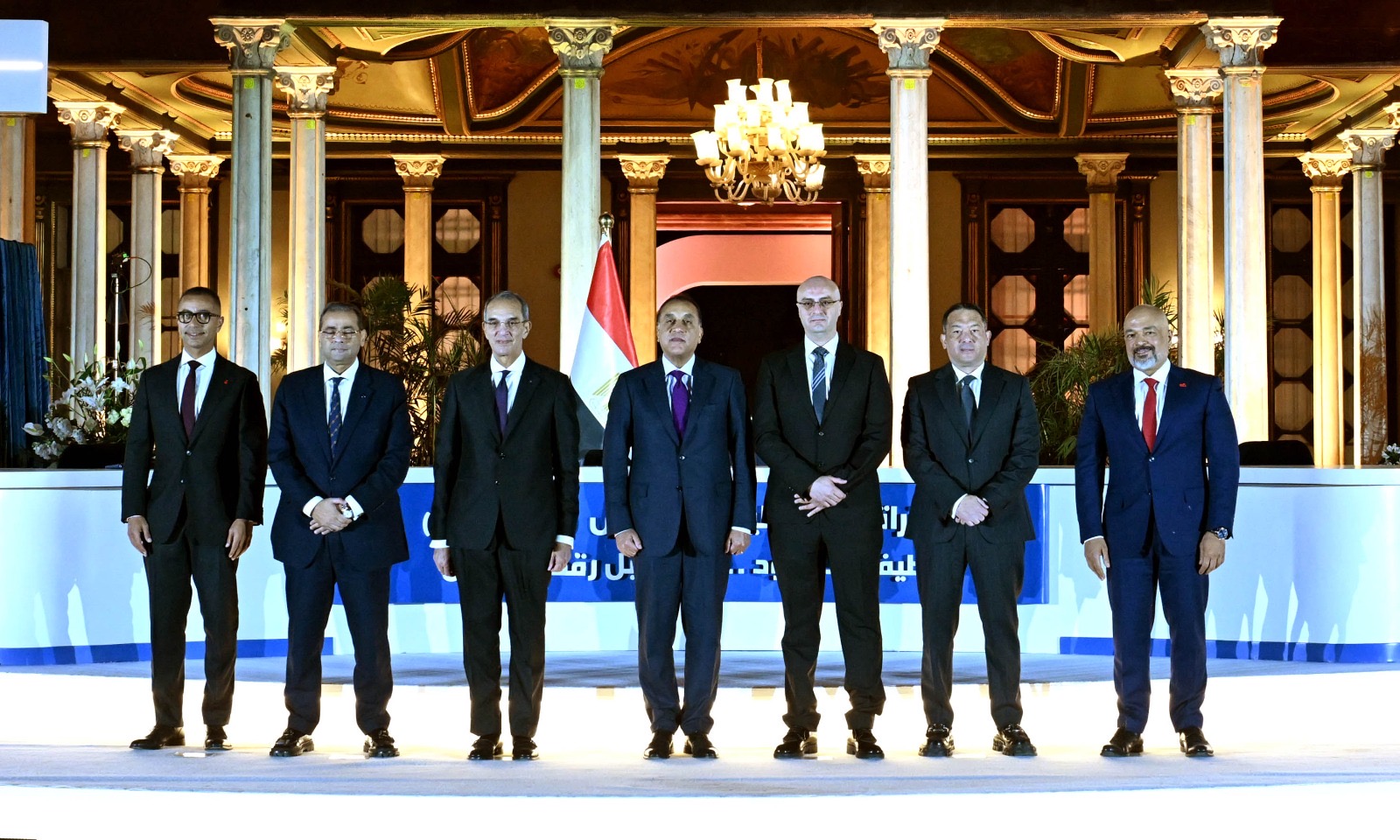
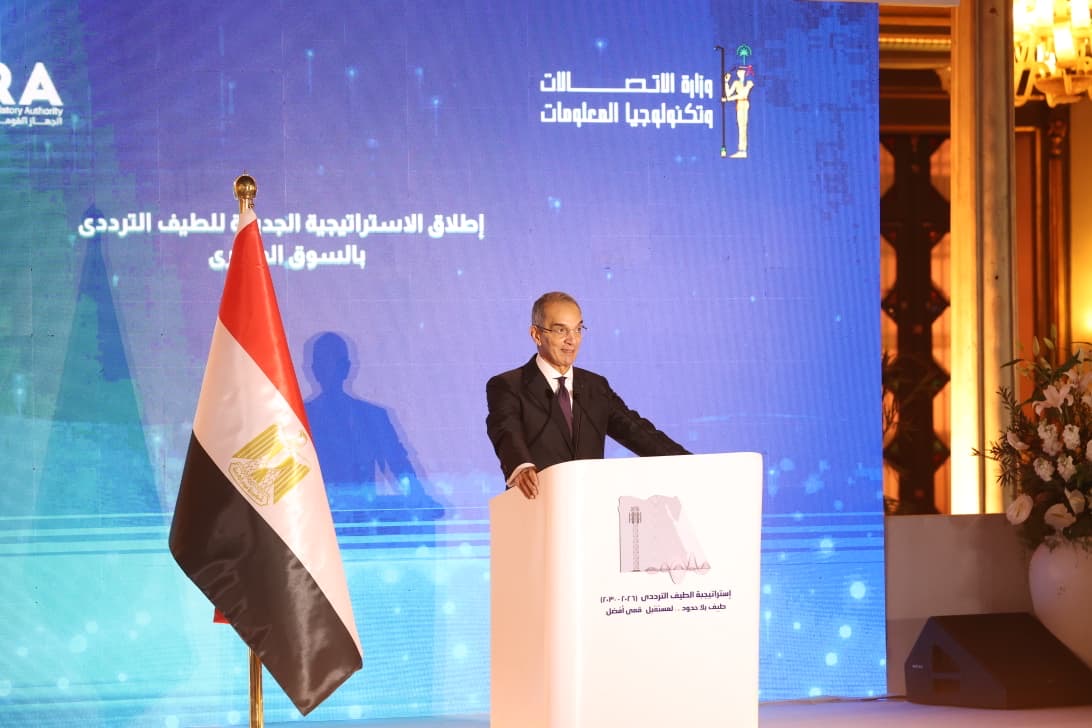
In the presence of the Prime Minister Signing the largest frequency deal witnessed by the mobile telecommunications sector in Egypt since its inception
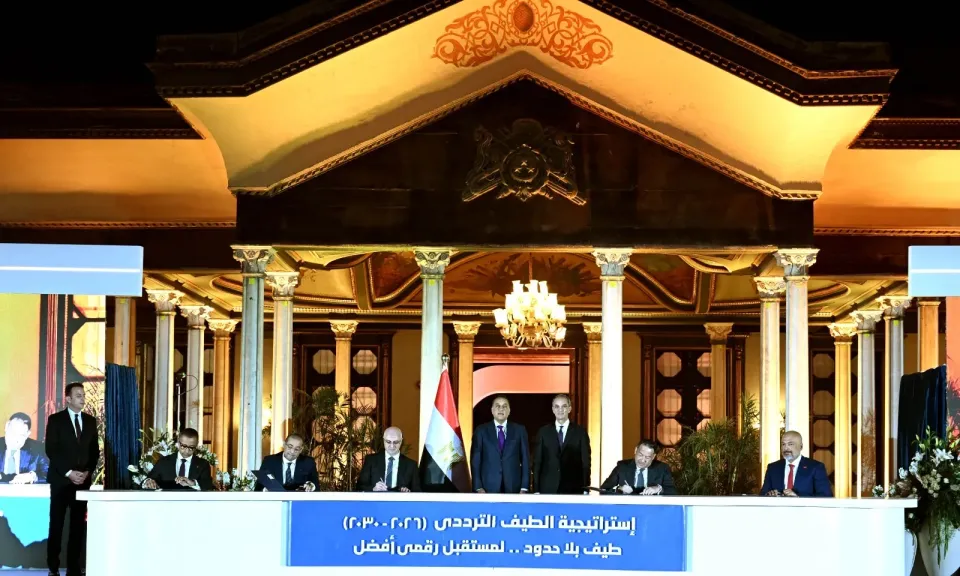
In the presence of Dr. Mustafa Madbouly, Prime Minister, Dr. Amr Talaat, Minister of Communications and Information Technology, delivered a speech during the signing ceremony of the largest frequency deal in the history of the telecommunications sector since the start of providing mobile services in Egypt, which was established by the Ministry of Communications and Information Technology.
In his speech; Dr. Amr Talaat stressed that the signing of agreements for the development of telecommunications services in Egypt represents a historic deal for this sector by all standards; as it is the largest frequency deal witnessed by the mobile telecommunications sector in Egypt since its inception thirty years ago; where the deal includes the provision of an additional 410 MHz for mobile companies; which is equal in capacity to all that has been made available over the past thirty years. He explained that the value of the deal is about 3.5 billion dollars, which is equivalent to more than a third of what the sector has attracted during three decades, as the total attracted by the ICT sector over the past thirty years amounted to $10 billion to obtain frequency capacities and licenses Operation.
Dr. Amr Talaat explained that this signing represents a new milestone that reflects the commitment of the Ministry of Communications and Information Technology to building a human-centered digital society. He added that Egypt's digital strategy aims to achieve four concerted goals, which is to adopt communications and information technology in a way that enables citizens to join job opportunities in the digital economy, access digital services, benefit from innovative mobility and emerging technologies, and produce economic value reflected in the Egyptian information society.
He pointed out that the first goal is to build digital capabilities to enable citizens to join job opportunities in the digital economy; adding that in a digital world in which geography is no longer a restriction on gaining opportunities, tomorrow the acquisition of digital skills and information specializations is the most important bridge to join global markets and self-employment platforms, and participate in the implementation of Egypt's digital projects. He stressed the expansion of the government represented by the Ministry of Communications and Information Technology in digital capacity-building initiatives, where it is targeted to train 800,000 trainees during the current fiscal year, an increase of 200 times the number of trainees in 2018.
He stressed that the second goal is the rapid and efficient access of digital services through the expansion of digital transformation projects to reformulate the mechanisms of providing government services to the citizen, expand their availability channels and increase the efficiency of government work. He added that the Egypt Digital Platform was launched in 2022 and witnessed an increase in the number of services provided through it to reach more than 210 services within the framework of fruitful cooperation between the Ministry of Communications and Information Technology with all state entities and institutions, and partnership with the private sector. He stressed that the prospects for development are still wide in the path of promoting the concept of paperless participatory government to provide more advanced services to individuals and institutions.
He stated that the adaptation of technological mobility in the field of artificial intelligence and emerging technologies represents the third pillar of Egypt's digital strategy, in an effort to transform information developments into technology-based development opportunities as a socio-economic necessity, not a scientific and theoretical luxury. This curriculum is manifested in the applied projects that will be reviewed at the first conference for artificial intelligence in Africa and the Middle East (AI Everything), which will be held on February 11.
He pointed out that the fourth pillar revolves around transforming the sector into a productive service sector, providing job opportunities and its growing ability to attract investments, and contributing to exports and Egypt's GDP, making the ICT sector a strategic economic engine in Egypt. He added that the sector attracted 240 international companies exporting digital services from Egypt to the world with more than 170,000 job opportunities, pointing out that the sector's contribution to GDP exceeded 6%, up from 3.2% in 2018, and digital exports grew by more than 120% since 2018 to reach $7.4 billion in 2025, with the target of reaching 9 One billion dollars.
Dr. Amr Talaat explained that the digital infrastructure, including mobile and fixed Internet services, has always been a cornerstone for the construction of digital Egypt; and that from this point of view, the state has invested over the past years about 6 billion US dollars to develop mobile networks, enhance the efficiency of the fixed terrestrial Internet, expand coverage in rural and urban areas, and improve the quality of services throughout the republic, to ensure the readiness of the digital infrastructure to keep pace with the requirements of the citizen in the digital age. He added that the path of developing digital infrastructure began from the fixed terrestrial Internet, where 3.5 billion dollars were invested in modernizing networks and raising their efficiency at the level of the Republic, which laid a solid foundation for the increasing dependence on Digital services have led to the doubling of the average Internet speed of 16 times since 2019, for Egypt to maintain the first place in Africa in the average fixed Internet speed for more than five years in a row.
He pointed out that the development of mobile services was based on two integrated tracks. The first track was to expand the deployment of towers and mobile stations, as the number of stations has been doubled since 2019 throughout the Republic, which contributed to expanding coverage and improving the quality of service. The second track is to maximize the available frequency capacities of mobile operators in Egypt, as a governing supplier in the network's ability to accommodate the growing demand for data.
Dr. Amr Talaat explained that the total frequency capacities available for mobile companies in Egypt before 2019 was equal to 272 MHz, allocated over more than two decades since the start of the provision of mobile services in Egypt; adding that during the period from 2019 to 2022, the state provided companies with an additional 140 MHz of the frequency spectrum, an increase of about 50% on frequency capacities, raising the total frequency capacities available to companies in 2022 until today to 412 MHz.
He added that the frequency capacities provided by the deal raised the total frequency capacities made available to companies since 2019 to 550 MHz in an unprecedented expansion in the history of spectrum management in Egypt, explaining that this huge expansion in frequency capacities comes in continuation of what was achieved in June 2025 with the launch of 5G services, to ensure the readiness of networks to accommodate the applications of the future. He stressed that the signing of agreements on the availability of the frequency spectrum with their enormous investment value and clear strategic significance is not a passing technical procedure, but a long-term strategic step, in which the state's vision converges with the partnership of the private sector, to reshape the structure of telecommunications in Egypt.
Dr. Amr Talaat expressed his sincere appreciation to the Prime Minister, Dr. Mustafa Madbouly, for the continuous support he showed, which had the greatest impact on creating an investment climate in the ICT sector. He also thanked the Egyptian Armed Forces and other concerned national institutions, and all those who contributed to the success of this process, reflecting the spirit of institutional work and integration between state organs.
He thanked the companies operating mobile services in Egypt for their long-term investment commitment, and the resources they inject to develop networks and raise the efficiency of services, in a partnership that reflects confidence in the Egyptian market and the stability of its regulatory policies.
He expressed his appreciation to the team of the National Telecommunications Regulatory Authority led by Eng. Mohamed Shamroukh for their sincere and tireless effort to strengthen constructive partnerships with mobile operators in Egypt, and to provide a regulatory environment that supports the development of digital infrastructure in Egypt.