
Dr. Amr Talaat: Expansion of digital services, capacity building and development of digital infrastructure are the pillars of progress in the classification of the digital government maturity index
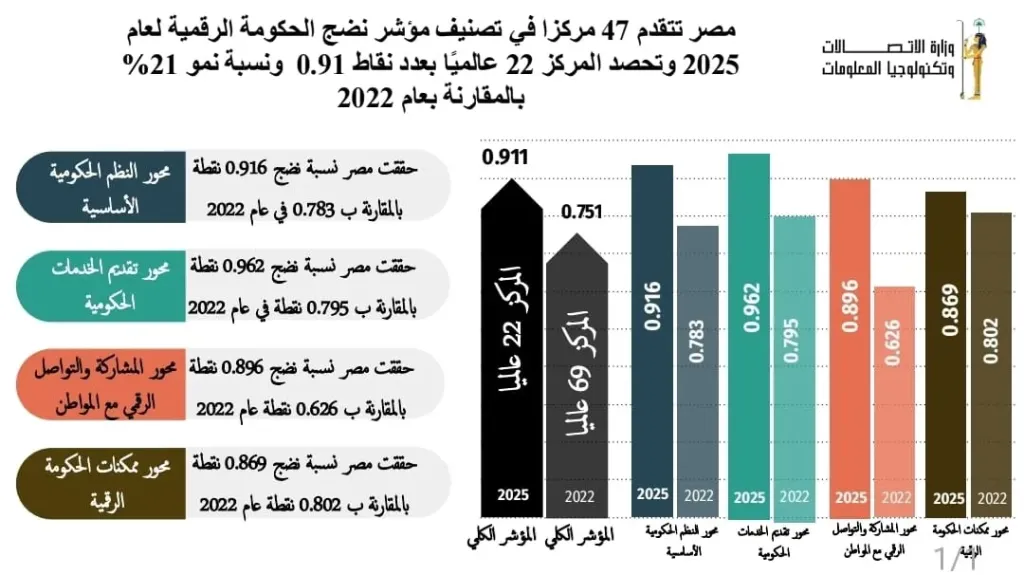
Egypt advanced 47 positions in the classification of the Digital Government Maturity Index for 2025 issued by the World Bank, where it strengthened its position within the group of leading countries in digital government in category (A), which is the highest category in the index, to reach 22nd place globally with a maturity rate of 0.911 points out of 1, compared to 69th place with a maturity rate of 0.751 points in the previous report issued in 2022.
This year's release witnessed great progress achieved by Egypt at the level of all the main axes of the index compared to the 2022 report. The maturity rate in the axis of supporting basic government systems (mechanization) rose to 0.916 points, compared to 0.783 points. The evaluation of the axis of providing digital government services rose to 0.962 points, compared to 0.795 points, and the maturity rate of the digital participation and communication axis with citizens increased to 0.896 points, compared to 0.626 points. The digital government enabled axis also recorded a rise to 0.869 points, compared to 0.802 points.
Dr. Amr Talaat, Minister of Communications and Information Technology, stressed that this progress achieved by Egypt in the classification of the Digital Government Maturity Index for 2025 issued by the World Bank reflects the success of the efforts of the Ministry of Communications and Information Technology in implementing Egypt's digital strategy to achieve digital transformation, and supporting an effective environment for digital government in Egypt. He explained that these efforts are based on a number of key pillars, most notably the mechanization of government processes and services and expansion of digital government services through the Egypt Digital Platform, and encouraging the use of modern technology in the work system in the government sector as well as providing technical support for government platforms for interacting with citizens; adding that these efforts are integrated with Work on developing the digital infrastructure and raising its efficiency, to ensure the expansion of the availability of digital services, in addition to adopting policies and legislation that support digital transformation, including the launch of the open data policy.
Dr. Amr Talaat pointed out that investing in building digital capabilities is at the forefront of the ministry's priorities, through the implementation of integrated programs to prepare and qualify cadres in various technological disciplines, and develop digital capabilities for employees of the state administrative apparatus, thus enhancing the ability of state institutions to absorb and employ modern technologies. He stressed the Ministry's keenness to support digital innovation in the field of government technology through a number of programs and initiatives, most notably the launch of the "Government Innovation Lab" initiative at the Digital Egypt Creativity Center in Giza, to empower innovative startups working in the field of government technology, and contribute to improving the quality of digital government services.
Egypt has achieved a jump in the digital government maturity index over the past five years, moving from the high-performing countries category (B) with a maturity rate of 0.649 in 2020, to the highest category (A) by 0.751 in 2022, to strengthen its position this year in category (A) with progress in the maturity rate of 21.3%, which puts Egypt in the ranks of the world's leading countries in the field of digital government maturity.