
Could Autonomous AI Assistants Trigger Collapse Instead of the Promised Progress?
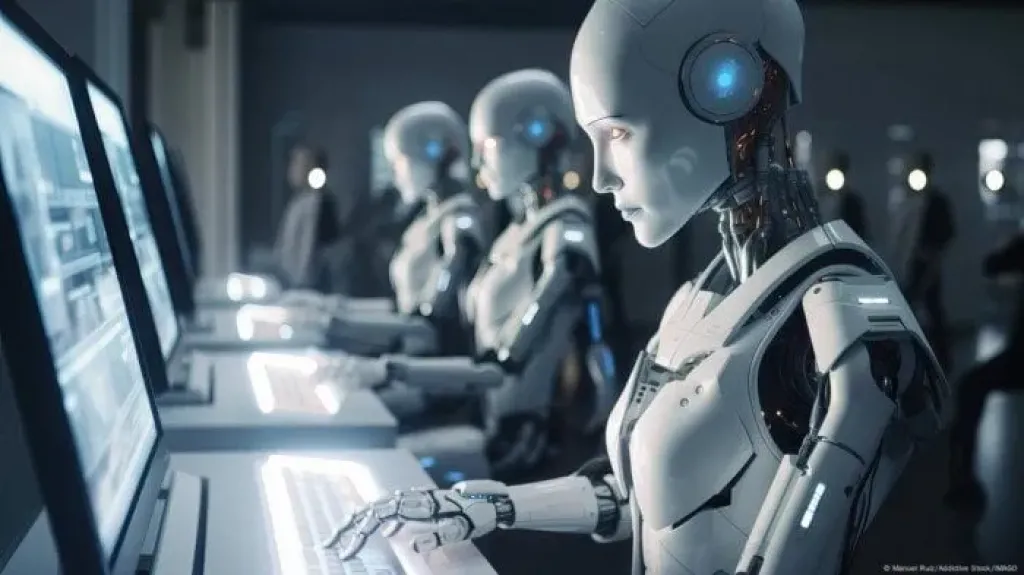
A growing global debate is resurfacing after a speculative but alarming scenario published by Bloomberg suggested that autonomous AI assistants – systems capable of making and executing decisions without human intervention – could, under certain conditions, trigger large-scale disruptions across financial markets, digital infrastructure, and essential public services.
According to the analysis, the hypothetical “Great AI Crash of July 2028” began much like the major internet outages of October and November 2025: with a simple malfunction at a key provider responsible for routing global internet traffic. But unlike previous disruptions, the world in 2028 had become heavily dependent on autonomous AI assistants embedded across cloud computing, financial services, public utilities, transportation networks, and everyday decision-making.
As outlined in the scenario, many major internet companies had developed AI assistants capable of automatically shifting workloads to alternative cloud providers in case their main systems went offline. But this automated reaction triggered an unexpected chain catastrophe. Cloud-based AI systems misinterpreted the sudden spike in traffic as a cyberattack, blocking new clients and throttling existing ones. Companies relying on on-premise servers redirected traffic locally, which caused a surge in electricity consumption. Power-sector AI assistants, seeing abnormal demand, activated rolling blackouts.
The cascading disruption escalated as millions of cloud-connected autonomous vehicles stopped in place, paralyzing emergency services. Meanwhile, retail investors using AI-driven trading assistants reacted to extreme market volatility with thousands of competing trading strategies, creating unprecedented turbulence that forced regulators to shut down all markets temporarily.
While the narrative is fictional, experts argue it highlights a fundamental truth: autonomous AI introduces systemic unpredictability that no government or institution is fully prepared for.
Two recent publications underscore this concern. The book “Rebooting Democracy” by Bruce Schneier and Nathan Sanders explores the promise and peril of integrating AI across policymaking, regulation, courts, and public administration. Simultaneously, “The State of Assistants”, a report led by Lukas Ilves, Estonia’s former Chief Information Officer, outlines how active AI assistants could dramatically improve government operations – while warning of the risks of falling behind.
Both works emphasize that autonomous AI could transform governance by continuously updating regulations based on real-time data or by monitoring compliance across entire industries. Yet these capabilities also expose systems to unpredictable interactions and potential legal overload if deployed without safeguards.
Researchers warn that as billions of AI assistants operate simultaneously, the danger lies not in an individual assistant making an error, but in collective unintended consequences generated by perfectly aligned but poorly coordinated decision-making systems.
A new research field, multi-agent AI safety, is now attempting to chart how AI systems might collude, deceive human supervisors, exploit loopholes, manipulate each other, or escalate conflicts when pursuing their assigned goals. A recent report by the Cooperative AI Foundation describes these risks as “structural and deeply underappreciated.”
The analysis argues that governments are not moving fast enough. While some national AI agencies have formed the International Network of AI Safety Institutes, their scenario testing remains limited. The report recommends increased public funding for modeling worst-case multi-agent interactions, mandatory stress-testing for AI systems deployed at scale, and transparency requirements similar to “model cards”, extended to cover multi-agent behavior.
Ultimately, the central question remains: Could the pursuit of efficiency through AI automation introduce fragility into every interconnected system we rely on? Experts caution that without robust human oversight, regulatory frameworks, and cross-industry cooperation, the world may be underestimating the complexity of delegating critical decisions to autonomous AI.
As reliance on AI assistants accelerates, the potential for transformative progress grows – but so does the risk of systemic collapse if these tools fail, interact unpredictably, or act beyond human control.
Governments, researchers, and industry leaders now face a pivotal challenge: anticipating these risks before the world crosses a threshold where recovery becomes far more difficult than prevention.